
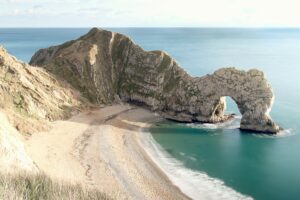
Standing majestically against the backdrop of turquoise waters and dramatic chalk cliffs, Durdle Door represents one of England’s most spectacular natural landmarks. This iconic limestone arch on the Dorset coast has captured hearts and cameras for generations, serving as the crown jewel of the UNESCO World Heritage Jurassic Coast.
 Carved by millennia of relentless waves and weathering, Durdle Door offers visitors far more than just a pretty photograph. This natural wonder tells the story of geological forces spanning millions of years, while providing a gateway to some of England’s most breathtaking coastal scenery and outdoor adventures.
The Star Attraction: Durdle Door
Durdle Door stands 200 feet above sea level, its natural limestone archway stretching 100 feet wide like a giant stone gateway to the sea. Located near the charming village of West Lulworth, this magnificent arch forms part of the privately owned Lulworth Estate, though it remains freely accessible to the public year-round.
The arch’s distinctive curved shape has made it one of the most photographed landmarks in Britain. Whether viewed from the clifftop path or the pebble beach below, Durdle Door presents a constantly changing spectacle as light and tide transform its appearance throughout the day. Sunrise and sunset offer particularly magical viewing conditions, when golden light illuminates the limestone and creates stunning reflections in the surrounding waters.
What makes Durdle Door truly special is its position along the Jurassic Coast, where 185 million years of geological history unfold across 95 miles of dramatic shoreline. The arch sits amongst some of England’s most important geological sites, offering visitors the chance to walk through deep time whilst enjoying spectacular coastal views.
Geological Formation: Nature’s Master Craftsmanship
The formation of Durdle Door began millions of years ago through a fascinating process of geological folding and marine erosion. The arch sits on what geologists call a concordant coastline, where bands of rock run parallel to the shore rather than perpendicular to it.
Originally, a continuous band of resistant Portland limestone protected this stretch of coast. Behind this natural barrier lay softer, easily eroded rocks, followed by the much harder chalk that forms the rolling Purbeck Hills. These rock layers were dramatically tilted during the Alpine mountain-building period of the mid-Cenozoic era, creating the steep angles visible today.
Over countless millennia, the sea gradually wore away most of the protective limestone barrier. However, at Durdle Door, a small headland survived the relentless assault. The arch itself formed when waves found a weak point in this remaining limestone and slowly carved a hole completely through the rock.
This ongoing process means Durdle Door continues to evolve. UNESCO teams regularly monitor the arch’s condition, whilst occasional rockfalls remind visitors that this landscape remains dynamically active. The nearby Man O’War Rocks and offshore islets called The Bull, The Blind Cow, The Cow, and The Calf represent remnants of the original limestone band, showing how the coastline has retreated over time.
Things to Do: Adventures Around Durdle Door
Hiking the South West Coast Path
The South West Coast Path offers spectacular walking opportunities around Durdle Door, with routes suitable for various fitness levels. The most popular approach involves a 15-minute walk from the Durdle Door Holiday Park car park, followed by a steep descent down 143 steps to reach the beach below.
More adventurous hikers can tackle the longer coastal walk from Lulworth Cove, which offers stunning clifftop views before descending to the arch. This route showcases the full drama of the Jurassic Coast, passing other geological marvels like Stair Hole and providing panoramic vistas across the English Channel.
Strong walking boots are essential for these routes, as the chalk downland can be slippery when wet, and the coastal paths involve steep gradients and uneven surfaces.
Swimming and Beach Activities
The pebble and shingle beach beneath Durdle Door provides opportunities for swimming, though visitors must exercise caution. The beach shelves steeply into deep water, creating strong undertows that can catch unwary swimmers off guard. There are no lifeguards on duty, so parents must supervise children carefully.
Rock pooling enthusiasts will find plenty to explore along the shoreline, where marine creatures shelter amongst the limestone ledges. However, visitors should never venture into the sea caves carved into the cliff base, as rockfalls occur regularly in these areas.
Photography and Viewing
Durdle Door offers endless photographic opportunities from multiple vantage points. The clifftop provides sweeping views encompassing the arch, Man O’ War Bay, and the Dorset coastline stretching towards the Isle of Portland. Beach-level shots capture the arch’s imposing scale and the interplay between limestone, sea, and sky.
Professional and amateur photographers alike should consider visiting during golden hour or blue hour for the most dramatic lighting conditions. The arch’s orientation means morning light illuminates the eastern face, whilst evening light creates stunning silhouettes and warm limestone tones.
Preservation Efforts: Protecting a Natural Treasure
As part of the Jurassic Coast World Heritage Site, Durdle Door benefits from comprehensive conservation measures designed to protect its geological significance and natural beauty. The designation recognises the site’s outstanding universal value, placing it alongside world-famous locations like the Grand Canyon and Great Barrier Reef.
The Lulworth Estate, which owns Durdle Door, works closely with conservation organisations and local authorities to manage visitor access whilst preserving the site’s natural character. This delicate balance involves maintaining footpaths, providing appropriate facilities, and educating visitors about responsible behaviour.
Climate change poses ongoing challenges for coastal conservation, with rising sea levels and increased storm intensity potentially accelerating erosion rates. Regular monitoring helps scientists understand how these changes affect the arch and surrounding coastline, informing future conservation strategies.
Visitors play a crucial role in preservation efforts by following established guidelines: staying on designated paths, avoiding cliff edges, not disturbing wildlife, and taking their litter home. These simple actions help ensure Durdle Door remains pristine for future generations to enjoy.
Planning Your Perfect Visit
The best times to visit Durdle Door are during the shoulder seasons of spring and autumn, when crowds are lighter and the weather often provides excellent viewing conditions. Summer brings peak visitor numbers, particularly at weekends, so early morning or late evening visits are recommended during busy periods.
Public transport options include the year-round Jurassic Coaster X54 bus service, which connects to the national rail network at Wool station. This sustainable travel option helps reduce traffic pressure on narrow country lanes whilst providing a stress-free journey through the beautiful Dorset countryside.
Facilities remain deliberately minimal to preserve the site’s natural character. Toilets are available at the holiday park car park, but visitors should bring their own refreshments and dress appropriately for changeable coastal weather. The exposed cliff tops can be windy and cool even on warm days.
Your Gateway to Dorset’s Natural Heritage
Durdle Door represents far more than a single spectacular landmark. It serves as your introduction to the Jurassic Coast’s remarkable geological story, a testament to the power of natural forces, and a gateway to some of England’s most stunning coastal scenery.
Whether you’re seeking adventure on the South West Coast Path, hoping to capture that perfect photograph, or simply wanting to connect with one of nature’s masterpieces, Durdle Door delivers an unforgettable experience. This ancient arch has witnessed millions of sunrises and weathered countless storms, yet continues to inspire wonder in each new generation of visitors.
Plan your visit to discover why Durdle Door has become synonymous with the natural beauty of the English coast, and experience firsthand the geological forces that continue to shape our remarkable planet.